
SILVERMANE
STUDIOS
Build the dashboard. Track the trends. Measure performance. But then get out of the chair.
Microsoft Excel was introduced in 1985. It is an extraordinary piece ofsoftware.
It can calculate, organize, model, chart, filter, forecast, summarize,and manipulate information with remarkable flexibility. There is a reason ithas survived for more than four decades.
But Excel was never supposed to become the nervous system of a majorindustrial organization.
And yet, in far too many companies, that is exactly what has happened.
Somewhere along the way, spreadsheets stopped being tools that supportedthe business and became the business.
Production schedules live in spreadsheets.
Work queues live in spreadsheets.
Staffing plans live in spreadsheets.
Capacity models live in spreadsheets.
Shortage lists live in spreadsheets.
Performance metrics live in spreadsheets.
And sometimes the only person who understands how one of thosespreadsheets actually works is currently on vacation.
That is not a system.
That is a single point of failure with conditional formatting.
There is a particular kind of organizational insanity that becomescompletely normal if you live with it long enough.
A critical report is updated every morning by one employee.
That employee knows where the data comes from.
They know which columns matter.
They know which formulas occasionally break.
They know which rows need to be manually corrected.
They know which information should be ignored.
They know which number is technically wrong but has to remain therebecause another report depends on it.
Then that person calls in sick.
Suddenly the organization loses situational awareness.
Someone asks:
"Who updates this?"
Nobody knows.
"Where does this number come from?"
Nobody knows.
"Can somebody refresh it?"
Maybe.
"Is this data current?"
Probably.
That should terrify leadership.
If a production organization cannot reliably understand its own workloadbecause one employee is unavailable, the problem is not that the employee tooka vacation.
The problem is the system.
This is where spreadsheet dependence becomes more than inconvenient.
It begins affecting decisions.
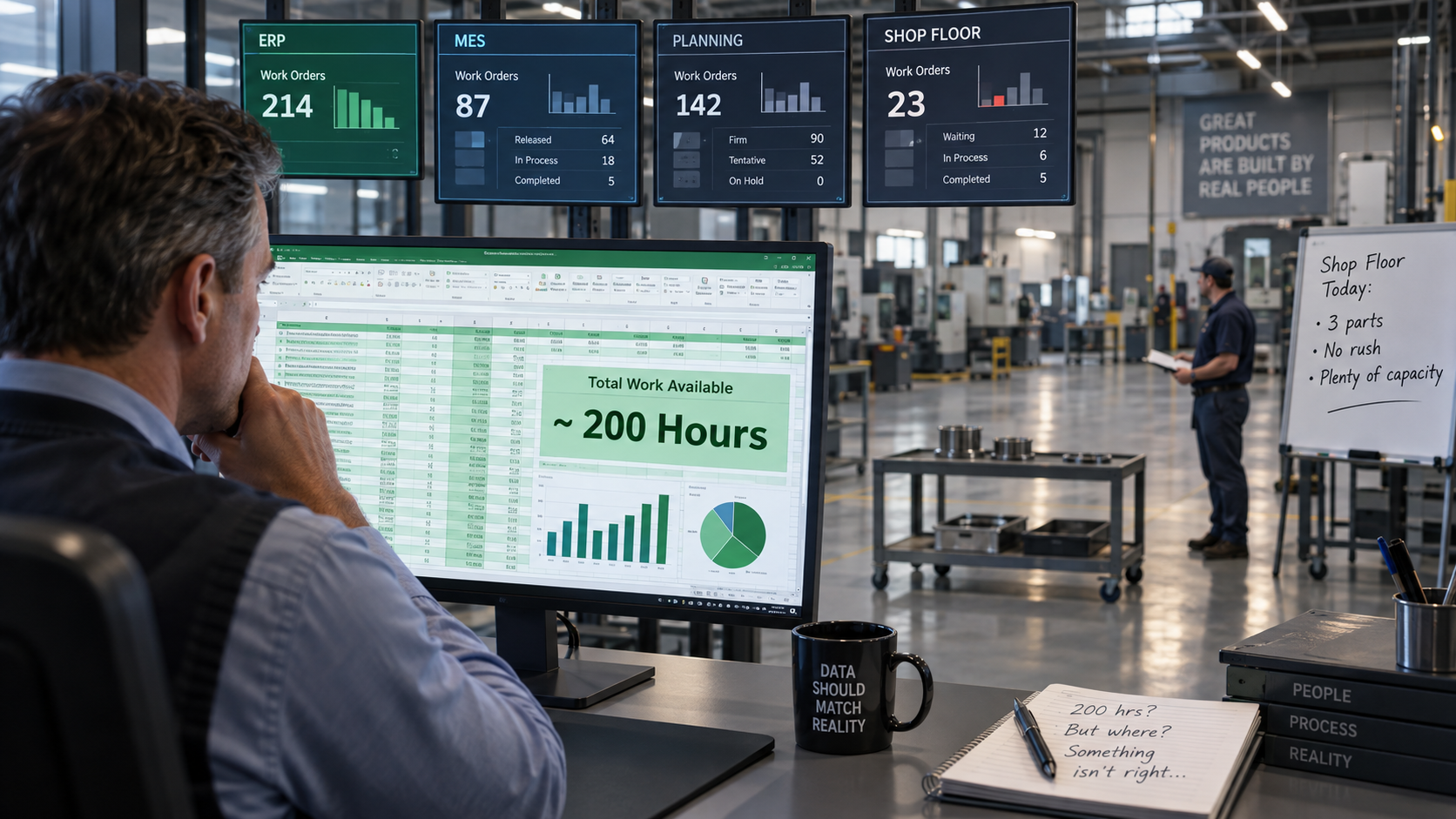
Imagine a management report showing 200 hours of available work inan area.
According to the data, the team has plenty to do.
The staffing model responds accordingly.
Leadership may move employees into the area.
Overtime may be authorized.
Production expectations may be increased.
Schedules may be built around those 200 hours.
There is only one problem.
Someone actually walks into the work area.
They look at the jobs physically available.
They talk to the employees.
They verify the parts.
They check what is actually ready to be worked.
There are perhaps nine hours of usable work.
Not 200.
Nine.
At that point, the spreadsheet has not merely become inaccurate.
It has become dangerous to the decision-making process.
The number may be technically correct according to whatever rules createdit.
Perhaps jobs exist in the system but cannot be started.
Perhaps the job tracking system is so vague that no-one actually knowswhere the parts are.
Maybe parts are missing.
Maybe upstream work is incomplete.
Maybe the system foolishly counts planned work as available work.
Maybe the definition of "available" makes perfect sensemathematically to people not on thefloor and absolutely no sense to people doing the work operationally.
Whatever the cause, a senior manager looking only at the screen can walkaway believing something completely different from what is being physicallyreported by their supervisors with boots on the ground.
Then comes one of my favorite organizational experiences.
Senior Manage: “Why did you loan out 3 of 4 of your team when you have somuch behind schedule work?”
System one produces one number. The spreadsheet produces another. Thescheduling tool provides a third. The “required to use” dashboard shows afourth.
Same parts. Same organization. Same moment in time.
Four answers.
You spend three minutes explaining that the “Must be used system” says wehave 9 hours available, as does the actual visual area inspection.
Queue the eight sets of confused staring eyes.
Someone defensively explains that their report counts work differentlybecause that is how so-and-so designed the spreadsheet.
This is what happens when organizations accumulate information systemswithout establishing a reliable source of truth.
Data becomes plentiful while knowledge becomes scarce. That distinctionmatters.
Having more numbers does not mean you understand the operation better.
Sometimes it means you have simply created more ways to be wrong.
The deeper problem is not Excel itself.
The deeper problem is what happens to leadership behavior whenspreadsheet reporting becomes the dominant way an organization understandsitself.
Managers begin managing what they can see on the screen.
A red cell receives attention.
A green cell does not.
A dashboard becomes reality.
And gradually, leaders spend less time where the work is actuallyhappening.
That is backwards.
The spreadsheet should help a manager know where to look.
It should never replace looking.
If a report says an area has 200 hours of work and the team lead and supervisorstanding in that area says there are nine, the next question should notautomatically be:
"Why doesn't your floor match my spreadsheet?"
The question should be:
"Why does our system believe work exists that our people cannotactually perform?"
That is a very different leadership mindset. One treats the spreadsheetas truth and the operation as the problem.
There are things no spreadsheet sees particularly well.
A skilled employee struggling with a new process. A workstation slowlybecoming disorganized. A supplier part that technically arrived but cannotactually be used.
Work that appears available but is physically not there.
A maintenance issue developing but no-one can see it because THAT systemis also limited in capability.
And you still have a team quietly compensating for a broken process thatleadership stubbornly believes is functioning perfectly.
You discover those things by being present. You walk. You look. You askquestions. You listen.
You compare what the system says with what the people actually performingthe work say.
The Japanese manufacturing world gave us the concept of gemba—goingto the actual place where value is created and understanding the situationdirectly.
Call it gemba.
Call it management by walking around.
Call it getting out of the office.
I do not particularly care what terminology you use.
Just go look. And have faith in the people reporting to you.
I am not advocating that companies abandon spreadsheets. That would beridiculous. Excel remains incredibly useful.
The problem starts when an organization allows locally maintainedspreadsheets to become authoritative business systems without the controls,integration, redundancy, ownership, validation, and governance expected ofactual enterprise systems.
A spreadsheet should answer a question. It should not become the onlyplace where the organization remembers the answer.
And managers should never surrender judgment simply because a numberappeared in a professionally formatted cell.
Good leadership combines data with observation. Numbers tell you wheresomething may be happening. People help explain why. The workplace tells youwhether the information corresponds to reality.
Those three things belong together.
Companies often tolerate spreadsheet-driven processes because replacingthem looks expensive.
But spreadsheet dependency has its own costs. People spend hoursreconciling reports. Employees manually enter the same information intomultiple systems.
Meetings are consumed by debates over whose data is correct. Decisionsare delayed while somebody "validates the numbers." Errors propagatethrough copied files. Different versions circulate simultaneously becausesomeone saved the sheet that was attached to an email.
Institutional knowledge becomes trapped inside the head of whicheveremployee built the workbook. And managers gradually become analysts ofreports rather than leaders of operations.
None of those costs appear neatly in a spreadsheet. Ironically.
Every organization should occasionally examine its critical processes andask:
If the person who maintains this spreadsheet disappeared tomorrow, wouldwe still know how our business works?
If the answer is no, that is not a staffing problem. It is anarchitecture problem.
Another useful question is:
When our systems disagree with what employees physically see in theworkplace, which one do we investigate first?
There is only one sensible answer… Reality.
Systems are supposed to describe the business. The business is notobligated to rearrange reality so the spreadsheet can remain correct.
Excel is not the enemy.
· Bad system design is.
· Poor data governance is.
· Siloed information is.
· Single-person dependencies are.
· And management cultures that trust thespreadsheet more than the people standing next to the product certainly are.
Use the data. Build the dashboard. Track the trends. Measure performance.But then get out of the chair. Walk into the operation.
Look at the work. Talk to the people doing it. Ask what is preventingthem from succeeding.
Because when four systems show four different answers for the same pieceof work, the fifth source may be the most important one of all:
The person actually standing there looking at it. That is the edge.